The 2nd KSE-ISE Webinar
April 7, 2025, Online
Incheon Sejong Hospital Hyung Yoon Kim

On April 7, 2025, at 7 PM (KST), the 2nd Joint Case-Based Webinar hosted by the Korean Society of Echocardiography (KSE) and the Indonesian Society of Echocardiography (ISE) was successfully held on an online platform. Over 300 people pre-registered for this webinar, with approximately 230 participants from overseas, reflecting the high level of interest from Indonesian medical professionals.
The session was chaired by Professor Park Seong-ji (Sungkyunkwan University School of Medicine) and Professor Amiliana Mardiani Soesanto (Harapan Kita Hospital, Indonesia), who led the entire program. The webinar was conducted in an interactive format using a real-time chat window and Professor Park Jin-oh (Inje University College of Medicine) participated as a facilitator, coordinating dynamic interactions between presenters and panelists. In particular, the enthusiastic participation and active discussions from the Indonesian attendees were remarkable, show the real potential for cross-border academic exchange.
In the first presentation, Professor Luh Oliva Saraswati Suastika (Udayana University) introduced a series of clinical cases involving various causes of chest pain, highlighting the value of echocardiography as a primary diagnostic tool. She emphasized the advantages of echocardiography as a rapid and repeatable screening modality, particularly compared to CT, and demonstrated its clinical usefulness in early evaluation. In the following presentation, Professor Risalina Myrtha (Sebelas Maret University) provided detailed case examples of hemodynamic profiling using Doppler parameters (such as LVOT VTI and SVR) in different types of shock patients. She underscored the essential role of echocardiography-based circulatory assessment in guiding initial management decisions.
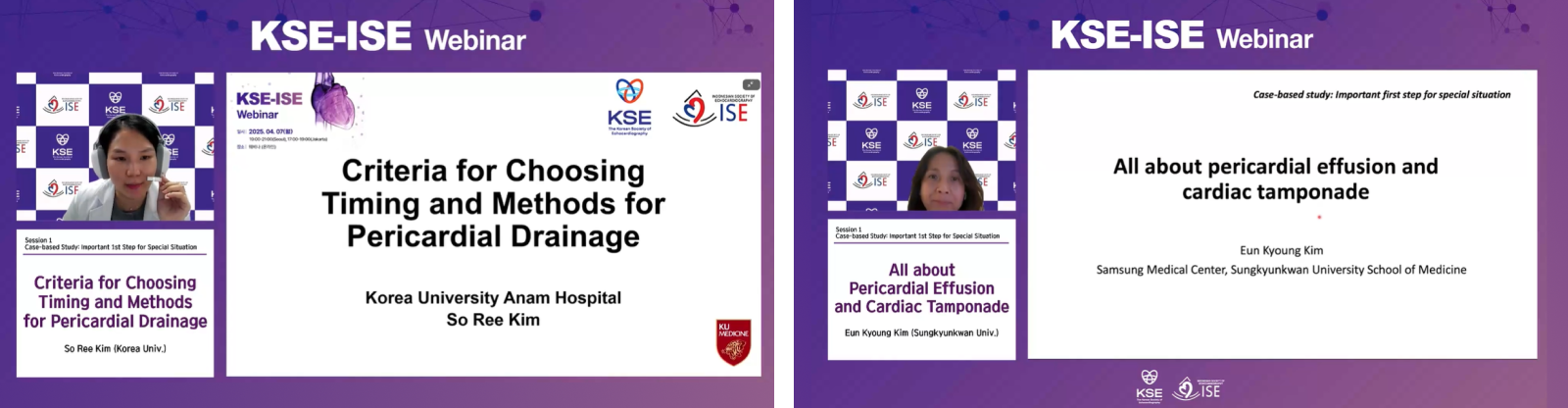
In the latter part of the session, Professor Kim Eun-kyung (Sungkyunkwan University School of Medicine) provided a comprehensive overview of the diagnostic and treatment criteria for pericardial effusion and cardiac tamponade. Professor Kim So-ri (Korea University College of Medicine) gave a detailed explanation of the indications for pericardiocentesis and the criteria for selecting the appropriate approach. The session offered valuable clinical insights through the discussion of practical, real-world questions—such as criteria for follow-up when the need for drainage in moderate pericardial effusion is unclear, concerns about side effects when administering colchicine in malignant pericardial effusion, and the applicability of fluid differentiation tools like Light’s criteria.
This webinar served as a meaningful platform to revisit the role of echocardiography in various high-risk clinical scenarios and allowed experts from Korea and Indonesia to exchange experiences and broaden their perspectives on diagnostic and therapeutic strategies. We look forward to continued and even more active international academic collaboration in the future.