The 7th KSE Echo Webinar
August 20, 2025, Online
Catholic Univ. Ji-Hyun Kim
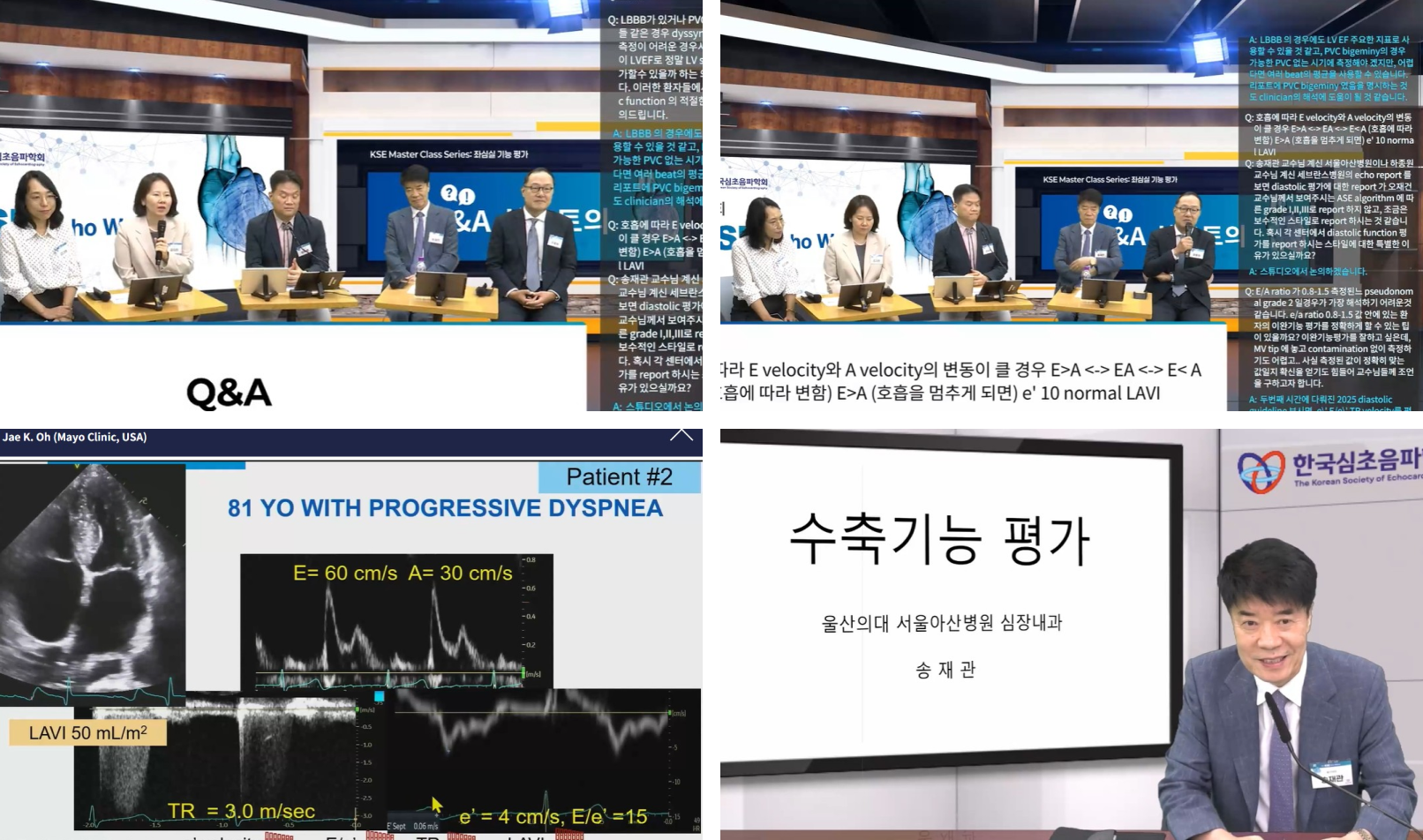
Master Class, beyond the Basic of echo
When I first received the invitation to serve as a panelist for this webinar, I thought it would be an easy topic like the other panel members and facilitator professors, so I comfortably accepted. However, upon reviewing the names of the speaker professors again, I realized this was a panel role for a master class, not a basic course. I felt both the burden of responsibility and the excitement of receiving such an honorable opportunity. While listening to the excellent lectures from the three distinguished professors, I came to realize that assessing systolic and diastolic function through echocardiography is not simply about discussing LVEF, RWMA, or the grade of diastolic dysfunction. Rather, every parameter we measure through individual patient echocardiography examinations serves to evaluate these two functions.
Professor Song Jae-kwan passionately delivered his lecture, starting with the basics that should never be overlooked—such as selecting appropriate gain values to accurately delineate the endocardium based on quality cardiac images and ensuring continuous respiratory control during examinations. He went beyond emphasizing proper image acquisition methods to discuss commonly overlooked issues in the examination room, such as whether stroke volume values might be measured incorrectly due to various errors or whether truly low SV values were accurately measured, using appropriate case examples for each situation. Professor Oh Jae-geon's lecture provided an update on the overall ASE guidelines for diastolic function assessment released this year. He clearly explained how the new guidelines have become more intuitive and clinically applicable compared to the previous guidelines, which contained somewhat ambiguous content. The very next day, we removed the old diastolic function assessment charts from the previous guidelines posted throughout our echo lab and replaced them with the new diagnostic criteria flowcharts to evaluate diastolic function. During Professor Ha Jong-won's case-based lecture on the clinical application of left ventricular function assessment, the impressive points included the caution needed when using beta-blockers in patients showing restrictive physiology, the clinical application of using mitral inflow to assess not only diastolic function but also volume status in patients with various clinical illnesses, and the usefulness of exercise stress echo.
The level of questions appearing in the real-time chat during the three professors' passionate lectures was quite high. Many questions were raised with the use of cases where there was a mismatch between actual measured values and diagnostic criteria. It was very regrettable that there were time constraints preventing real-time responses to all questions. Among participants, there was a common opinion that it would be great to have a forum, either in a future Webinar or echocardiography conference, where such cases could be collected and discussed. I hope this topic will be well addressed in an upcoming Webinar or conference.